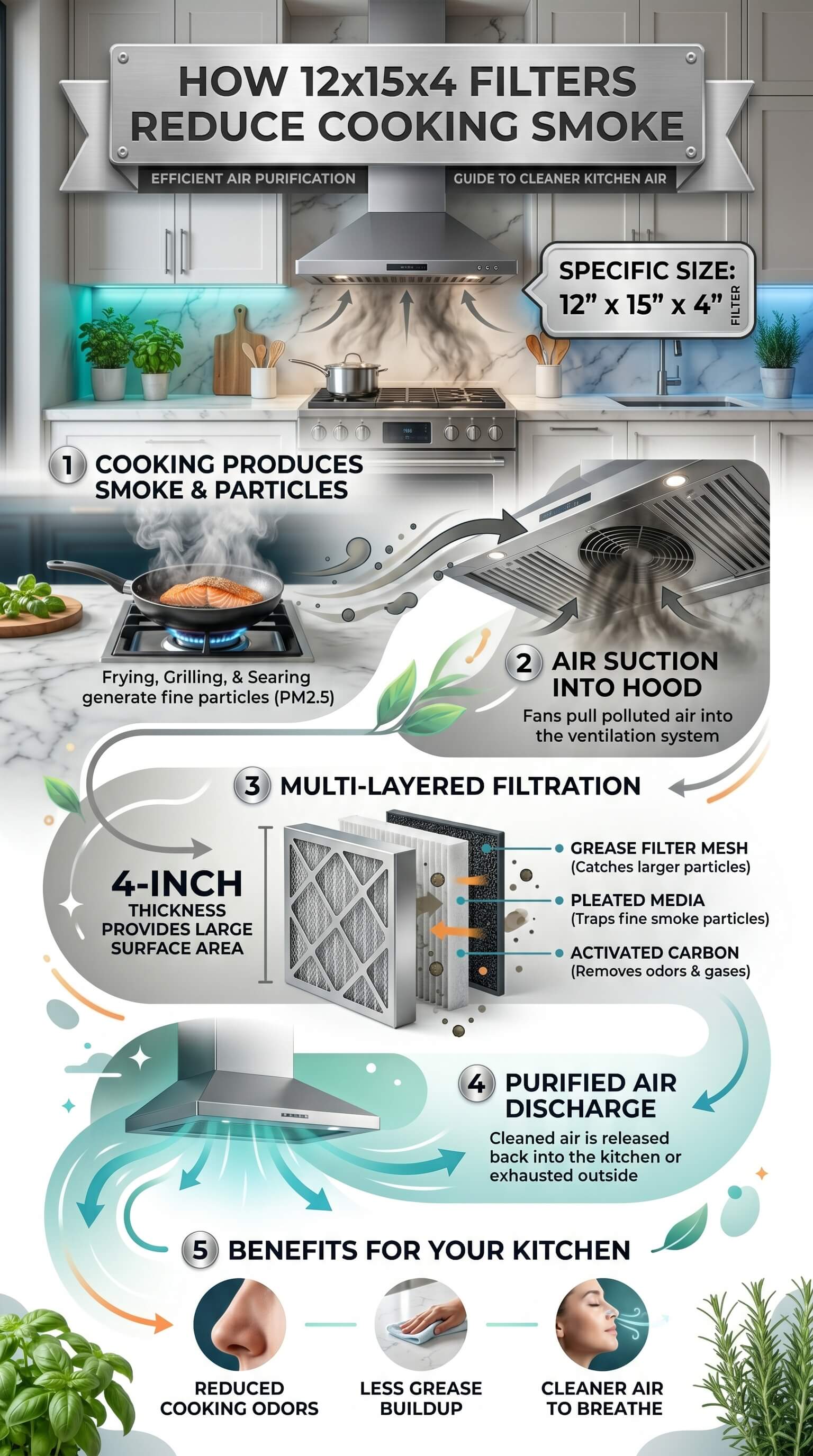
The salmon you cooked on Tuesday is still in your air on Thursday morning. We don't mean the smell, although that's part of it. We mean the actual grease droplets and smoke particles that slipped past your range hood and got pulled into your HVAC return, where they've been recirculating ever since.
After a decade-plus of making filters for households across the country, we keep seeing the same pattern. The right-sized, right-rated filter at the return grille quietly handles what the hood didn't catch. If your return uses a 12x15x4, you've got one of the better setups in residential HVAC for catching cooking emissions. This guide shows how to make yours earn its keep.
TL;DR Quick Answers
12x15x4 Air Filters
A 12x15x4 air filter is a 4-inch-deep HVAC filter that fits return grilles labeled 12 by 15 inches nominally. The deeper frame gives it roughly four times the pleated media surface area of a standard 1-inch filter, so it captures more particles, runs at lower static pressure, and typically lasts 6 to 12 months between replacements.
Quick facts:
Best MERV rating: We recommend MERV 13 for capturing cooking smoke (PM2.5), pet allergens, and bacteria-sized particles in a residential system.
For odor control: Pair MERV 13 with an activated-carbon layer to grab the VOCs that mechanical filtration can't catch on its own.
Replacement cadence: Every 6 to 9 months in an average home. Every 4 to 6 months for daily cookers, pet households, or homes that catch wildfire smoke.
Variants to know: Pleated synthetic at MERV 13 for most homes. Fiberglass for the lowest airflow restriction. Electrostatic or washable when reusability matters more than peak fine-particle capture.
Buying tip: Bulk multi-packs are the easiest way to stay on schedule and keep per-filter cost down.
Top Takeaways
A 12x15x4 packs about four times the pleated surface area of a 1-inch filter, which means more capture, less airflow restriction, and a longer service life.
MERV 13 is the sweet spot for capturing cooking smoke (PM2.5), pet allergens, and bacteria-sized particles in a residential system.
Activated carbon is what attacks odor molecules and VOCs. Mechanical filtration alone won't grab gases.
Replacement cadence: 6 to 9 months in an average home, 4 to 6 if you cook daily, have pets, or live through wildfire seasons.
Bulk-buying is the easiest way to avoid the most common failure mode: running a saturated filter because you forgot to reorder.
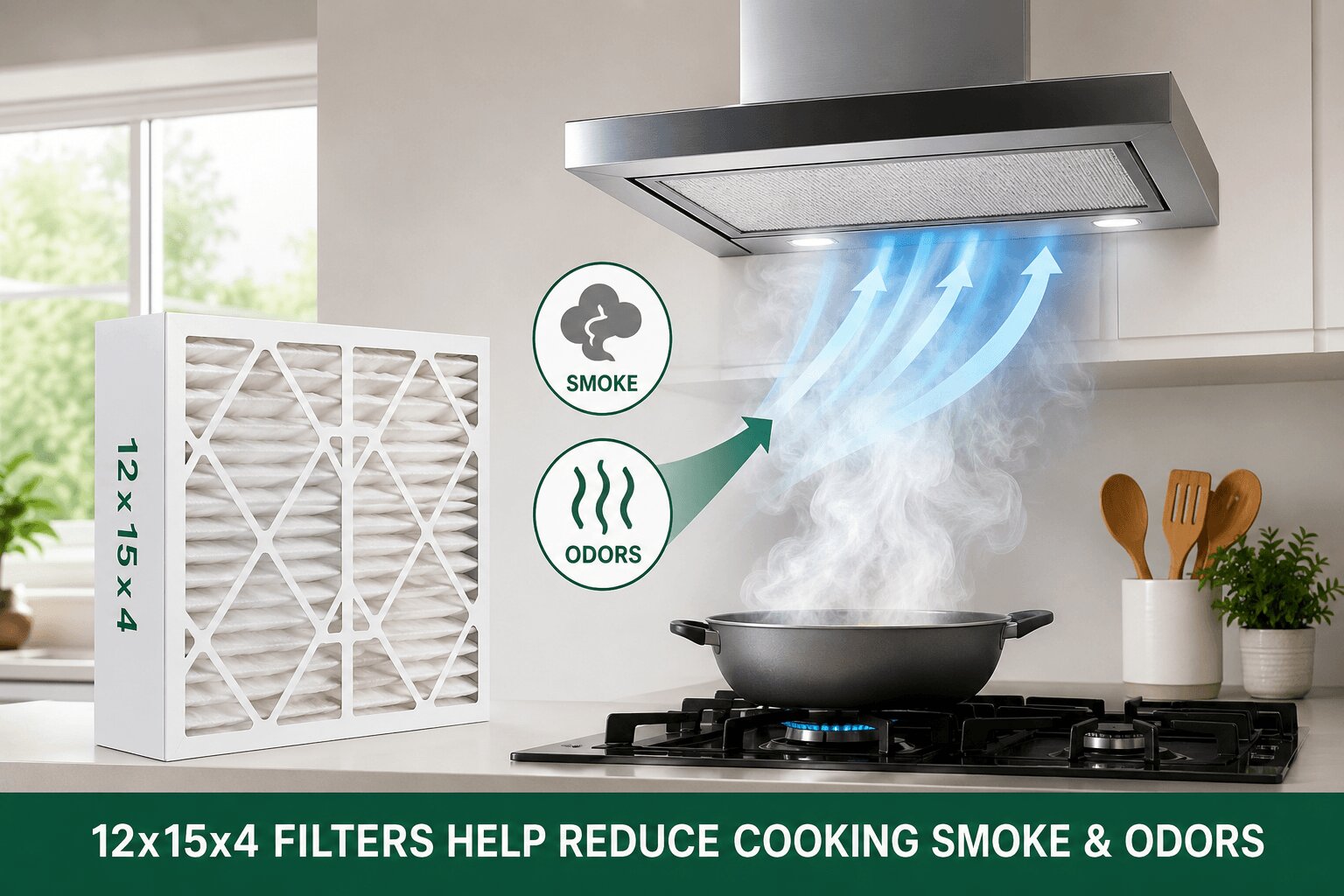
Your range hood is the first line of defense. Your 12x15x4 is the one running every minute your HVAC is on.
How a 12x15x4 Filter Fights Cooking Smoke and Odors
What's Actually in the Air After You Cook
Cooking puts more than smell into your air. Grease aerosols come off the pan and end up coating your evaporator coil over a season. PM2.5 smoke particles are fine enough to slip past a range hood and reach the lungs. VOCs are the gas molecules your nose reads as "that fish smell." Frying spikes particles the most, and gas stoves add nitrogen dioxide on top of everything else.
Why a 4-Inch Filter Beats a 1-Inch
A 12x15x4 air filter packs roughly four times the pleated media surface area of a standard 1-inch filter. Surface area is the whole story. More media catches more particles per pass and runs at lower static pressure, which means your filter lasts 6 to 12 months instead of the 30 to 90 days you'd get from a thin one. If you cook multiple times a day, that depth separates a filter that keeps up from one that gives up by month two.
MERV Rating, Decoded
MERV tells you how small a particle the filter can catch. For cooking smoke and odors, MERV 13 is the practical sweet spot in residential systems. It captures the fine PM2.5 fraction that range hoods miss, plus tobacco-smoke-sized particles and the cooking-oil aerosol that builds up on coil fins. MERV 8 handles dust and pollen but lets fine smoke straight through. MERV 11 sits between the two, which makes it a sensible middle ground if your blower can't take the airflow drop of MERV 13. Odor molecules are a separate problem. Those are gases, not particles, so mechanical filtration won't grab them. You need an activated-carbon layer for that job.
The 12x15x4 Variants Worth Knowing
The 12x15x4 size comes in several builds, and picking the wrong one is a common mistake. Pleated synthetic media at MERV 13 is what we recommend for smoke and allergen capture in most homes. A 12x15x4 fiberglass air filter has the lowest airflow restriction but doesn't do much for odors or fine particles. A 12x15x4 electrostatic air filter uses charged media to grab small particles, and the washable versions appeal to households that want to skip the disposable cycle, although their fine-particle capture rarely matches a fresh pleated MERV 13. If allergies are your driver, a 12x15x4 allergen air filter built specifically as a 12x15x4 air filter for allergies pairs MERV 13 capture with carbon adsorption. That's the closest thing to a one-filter answer for households dealing with cooking smoke, pet dander, and seasonal pollen at the same time.
Replacement Cadence for Cooking-Heavy Households
Plan on 6 to 9 months between replacements in an average home. Daily gas-stove cooking, a recirculating range hood that doesn't vent outside, or wildfire-smoke season will all shorten that window. We tell customers to inspect every month no matter what their schedule says, because cooking habits change and filters tell on themselves visually. Buying a 12x15x4 air filter bulk pack at the start of the year is the easiest way to avoid the "I'll change it next week" loop that ends up running a saturated filter for an extra two months.
"After more than a decade of cutting media and testing filters in real homes, the same pattern shows up: households that swap a 1-inch builder filter for a 4-inch MERV 13 with carbon tell us within two weeks that the next-morning cooking smell is gone. Your range hood is off most of the day, but that 12x15x4 in your return runs every minute the system is on, and that's the difference."
— Filterbuy Product Engineering Team
Seven Essential Resources for Cleaner Cooking Air
Seven places worth bookmarking. These are the same sources we point our own customers to when they want to dig deeper:
Guide to Air Cleaners in the Home (EPA): A consumer-friendly overview of HVAC filters and portable cleaners, including MERV selection. https://www.epa.gov/indoor-air-quality-iaq/guide-air-cleaners-home
Indoor Air Quality (EPA): The hub page for understanding sources, health impacts, and mitigation strategies for indoor pollutants. https://www.epa.gov/indoor-air-quality-iaq
The Inside Story: A Guide to Indoor Air Quality (EPA): EPA's most-cited consumer publication on indoor pollutants and source control. https://www.epa.gov/indoor-air-quality-iaq/inside-story-guide-indoor-air-quality
Air Conditioner Maintenance (U.S. Department of Energy): Federal guidance on cleaning and replacing HVAC filters and why it matters for energy use. https://www.energy.gov/energysaver/air-conditioner-maintenance
Is Cooking Making Your Indoor Air Unsafe? (American Lung Association): A plain-language breakdown of cooking-related particulates, VOCs, and combustion byproducts. https://www.lung.org/blog/cooking-air-pollution
Particulate Matter Indoors (American Lung Association): Explains the difference between PM2.5 and PM10 and the indoor sources, including frying, grilling, and gas-stove use. https://www.lung.org/clean-air/indoor-air/indoor-air-pollutants/particulate-matter
Air Filter (Wikipedia overview of mechanical filtration media): A technical primer on how mechanical filters trap airborne particles.
Three Numbers That Reframe Your Indoor Air
Three figures from federal agencies that explain why filter choice matters more than most people realize.
Indoor air can run 2 to 5 times more polluted than outdoor air, and occasionally more than 100 times higher, according to EPA exposure studies. Cooking is one of the top contributors. Source: EPA Reference Guide for Indoor Air Quality
Replacing a clogged filter can reduce HVAC energy use by 5 to 15%, per the U.S. Department of Energy. A high-capacity 12x15x4 that stays clean longer compounds those savings. Source: U.S. DOE Air Conditioner Maintenance
Americans spend about 90% of their time indoors, according to the EPA. The air your HVAC pulls through the return is the air your family breathes for most of the day. Source: EPA Guide to Air Cleaners in the Home
Final Thoughts and Our Honest Opinion
After years of testing filters in homes where cooking happens every day, here's the straight take. A 12x15x4 is one of the most underrated upgrades in residential HVAC. You get the surface area to capture more, the lower static pressure to keep your blower happy, and a service life long enough that you stop thinking about it. Pair it with MERV 13 plus activated carbon and, for our money, you've got the best practical answer to lingering cooking odors short of replacing your range hood.
It isn't a magic fix. A vented hood used every cooking session is still doing the heavy lifting, because capture beats filtration when emissions are still at the source. But for everything that escapes the hood (which, in homes with recirculating models, is most of it), your 12x15x4 is on the job every minute the system runs. That's the invisible work made visible, and it tends to show up first as a kitchen that doesn't smell like last night.
Frequently Asked Questions
Can a 12x15x4 air filter really reduce cooking smells?
Yes, especially when it pairs MERV 13 pleated media with an activated-carbon layer. The pleats catch grease droplets and smoke particles. The carbon adsorbs the gas molecules your nose actually reads as "smell." Most households see a clear difference in next-morning kitchen air within two weeks.
Do I need activated carbon, or is MERV 13 enough on its own?
MERV 13 on its own is excellent for particles, but it won't touch gaseous odors. If smell is your main frustration, carbon isn't optional. If you mostly cook low-VOC dishes and you're after particle protection for allergy reasons, MERV 13 without carbon is still a real upgrade.
How often should I replace a 12x15x4 filter in a household that cooks daily?
Every 4 to 6 months is a safe rule for daily cookers, with monthly visual checks in between. If the pleats look uniformly gray or yellow, replace it regardless of what the calendar says. Pet households, gas-stove households, and homes that catch wildfire smoke each year should lean toward the shorter end of that window.
Will a higher-MERV 12x15x4 filter strain my HVAC system?
Usually not, and that's the whole advantage of a 4-inch filter. The deeper pleat pack spreads airflow resistance across far more surface area than a 1-inch filter, so even MERV 13 in a 12x15x4 typically runs at a lower static pressure than a 1-inch MERV 8. Check your blower's specs if you're jumping more than one MERV step up from where you've been.
Is a washable 12x15x4 filter as effective as a disposable pleated one for smoke?
For smoke specifically, no. Washable and electrostatic 12x15x4 air filters are convenient and they cut down on waste, but their fine-particle capture is typically well below a fresh pleated MERV 13. If smoke and odors are the priority, a disposable MERV 13 pleated filter with carbon is the better build.
Is the best 12x15x4 air filter different for allergies versus odors?
A little. The best washable air filter 12x15x4 might suit a low-emission household where allergies are the only concern. For allergies plus odors, look for a 12x15x4 allergen air filter built on MERV 13 pleated media with a carbon-impregnated layer. That combination handles fine particulates and VOCs in one filter, so you're not stacking two separate solutions.
Stop Smelling Last Night's Dinner Tomorrow Morning
Cooking smells aren't a feature of your kitchen. They're a sign your filter is the wrong size, the wrong rating, or both.
Pick the right 4-inch carbon-enhanced filter sized for your return, and your HVAC system starts clearing the air every minute it runs. Bulk packs ship fast, drop your per-filter cost, and keep the next replacement waiting on the shelf when it's time.
Better Air For All starts at your return grille.
Filterbuy HVAC Solutions - Weston FL
2573 Mayfair Lane Weston FL 33327
(754) 296-3528
https://maps.app.goo.gl/E3tjmKf5VSWYghGc7